
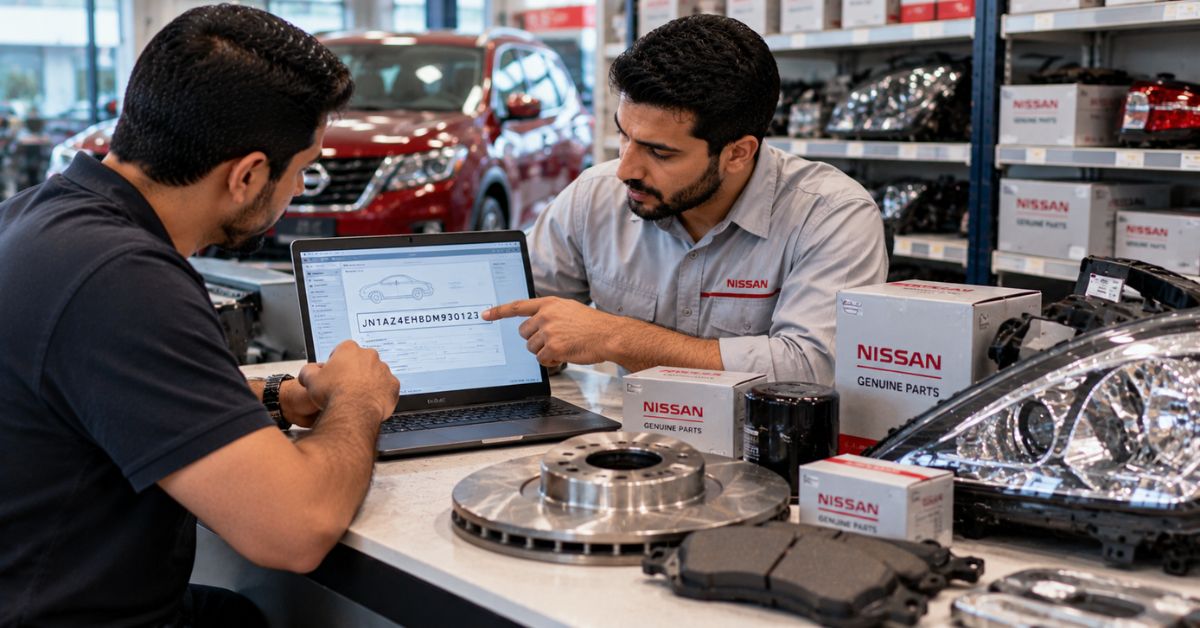
When ordering Nissan parts in Qatar, send your chassis number before asking for a final price. A model name and year can narrow the search, but they may still leave several possible versions of the same component.
The difference might be a headlight connector, a mirror camera, or a mounting bracket that changed during production. These details can turn a straightforward repair into another parts order and a second workshop visit.
Your chassis number helps the supplier identify the vehicle’s original specification and check the correct catalogue application. Here is how to use it properly.
Why the Model and Year Are Not Enough
Two Nissans with the same model badge and advertised year do not necessarily use identical parts. Trim level, engine, transmission, production date and original sales market can affect compatibility.
A registration year also does not reliably establish the manufacturing month. If a component changed partway through production, the supplier may need to check which side of that change your vehicle falls on.
This matters when buying for a vehicle in Qatar that was originally supplied to another market. Do not assume that being registered locally makes every GCC specification part suitable. Explain whether the vehicle was supplied for the Gulf market or imported, if you know.
What the Chassis Number Helps the Supplier Check
For many modern Nissan vehicles, the chassis number requested by a parts supplier is the 17-character Vehicle Identification Number, or VIN.
Used with the appropriate parts catalogue, it helps narrow down the vehicle’s original configuration. Depending on the catalogue and vehicle, the lookup can help establish the model variant, applicable production range and relevant equipment.
However, the number is a starting point, not a complete description of every fitted component. A basic VIN decoder may identify the vehicle without resolving every optional feature.
Ask the supplier to confirm the exact part number and its application to your vehicle. “Fits this model” is less useful than confirmation that the proposed item matches your chassis number and required specification.
Where to Find the Number Without Guessing
Start with your vehicle registration document, then compare its identification number with the number on the vehicle.
Depending on the Nissan model, identification details may be visible through the windscreen, on a door-opening label or at a stamped location on the body or chassis. Your owner’s manual shows the correct locations.
Take a clear photograph rather than relying only on a typed message. If you also type the number, check every character against the photograph.
Do not substitute the engine serial number, registration plate number or a code from the component being replaced. These identify different things.
If the number is unclear, shorter than expected or inconsistent between records, have it checked before ordering. Never add characters to make it fit an online form.
Parts That Need More Than a Visual Match
A photograph helps explain what you need, but appearance alone cannot confirm compatibility.
Headlights: Check the lighting type, side, electrical connections and whether the assembly includes the required control units. Similar outer shapes can conceal different wiring or equipment.
Door mirrors: Confirm electric adjustment, folding, heating, indicators and cameras where fitted. A mirror housing can fit the door while leaving an original function unavailable.
Bumpers and grilles: Check sensor openings, camera mounts, trim sections and brackets. Establish whether the quote covers a bare panel or an assembly with additional pieces.
SWAT’s auto body parts range lists categories including headlights, mirrors, bumpers, grilles, doors and fenders. Confirm the exact Nissan application and availability before paying.
Windscreens: Identify camera or rain-sensor provisions and the correct mounting arrangements. When arranging windscreen replacement in Doha, ask the installer whether your vehicle requires calibration after replacement and whether that work is included.
When the Original Specification No Longer Matches the Car
A chassis lookup describes the vehicle as originally built. It does not automatically account for later changes.
An earlier owner may have fitted different headlights, converted the front bumper or replaced an engine. A catalogue-correct replacement can therefore disagree with what is currently installed.
Tell the supplier about known modifications and previous major repairs. Send photographs of the existing component, its label, connectors and mounting points where accessible.
If the old part has no readable number, ask the workshop to document the relevant features before removal. Avoid accepting “it looks the same” as the only fitment check.
Why a Replacement Part Number May Be Different
A different number on the quotation does not automatically mean the supplier has selected the wrong item.
Nissan may replace an older catalogue number with a newer service part number. This is called a supersession.
Ask the supplier to verify the relationship between the old and new numbers for your application. Also ask whether the replacement requires any associated brackets, seals or other components.
Keep that confirmation with the invoice. If the supplier cannot explain the change, resolve it before installation.
What to Send With Your Parts Enquiry
Prepare one complete message containing:
- A clear chassis-number photograph.
- Model, approximate year and engine details, if known.
- The required component and quantity.
- Front or rear, and left or right, where relevant.
- Photographs of the existing part and any readable label.
- Relevant equipment, modifications and import details.
Describe left and right from the position of someone sitting in the vehicle facing forward. This avoids the confusion caused by looking at the car from the front.
Ask for a written quotation showing the part number, included components, condition, price in Qatari riyals, availability and expected collection or delivery time.
Confirm return conditions before ordering, particularly for special-order, electrical or painted items. Keep packaging and arrange inspection before painting or fitting. If something differs, stop and resolve it with the supplier instead of modifying it to fit.
Frequently Asked Questions
Can I order using only the last six chassis-number digits?
Send the complete number unless the supplier specifically requests a shorter reference. The final digits alone may not identify the full vehicle application.
Does a chassis-number match prove a part is genuine?
No. Compatibility and authenticity are separate checks. Ask the supplier to state whether the quoted item is genuine Nissan or an aftermarket replacement.
Can one chassis number be used for several parts?
Yes. It identifies the vehicle, but each requested component still needs its own correct part number, position and specification.
Should I send my whole registration document?
Usually, a clear image of the relevant vehicle identification details is enough to start an enquiry. Ask what is needed and cover unrelated personal information.

