
A cheaper replacement bumper can become an expensive purchase if it needs extra fitting work, arrives without brackets or does not suit the car’s sensors. When comparing genuine and aftermarket Mercedes-Benz body parts in Qatar, start with the exact component, its function and the complete repair cost.
Genuine parts are the manufacturer-backed choice. An aftermarket alternative needs closer checks on its source, specification and suitability. Before paying, ask these questions and get the important answers recorded on your quotation.
1. What exactly does “genuine” or “aftermarket” mean in this quote?
A genuine Mercedes-Benz part is supplied under the vehicle manufacturer’s brand and specification. An aftermarket part is supplied independently as a replacement. Neither “OEM quality” nor “original type” is enough to establish that an item is genuine.
Ask the seller to state the part’s category, manufacturer, identifying number and condition. Request photographs of the actual item and its labels, along with an invoice describing what you are buying. Packaging alone cannot establish authenticity.
Also distinguish new stock from used or repaired parts. A genuine panel removed from another vehicle has a different history from a new genuine panel, even if both carry the same identifying marks.
2. Has the part been matched to my chassis number?
A model name and registration year are not always sufficient. Production changes, body styles and factory equipment can affect compatibility. A part that resembles yours may still have different mounting points or openings.
Provide the full vehicle identification number, commonly called the chassis number, and ask for a catalogue-based match. Confirm:
- The correct side and position.
- Production date and pre-facelift or facelift specification.
- Body style and exterior equipment package.
- Relevant sensor, camera or washer provisions.
Mention any previous body-kit conversion because the current exterior may differ from the original specification. When enquiring about Mercedes-Benz parts at SWAT Auto Parts, include clear photographs of the existing component.
3. Does this part affect crash protection or safety systems?
A bumper cover, the reinforcement behind it and a decorative trim strip perform different jobs. Ask your repairer to identify precisely what needs replacing before comparing alternatives.
Mercedes-Benz’s published collision-repair position recommends genuine replacement parts and does not approve aftermarket collision parts. That matters when a seller describes an alternative as “equivalent” without evidence.
For structural components, impact-management parts and safety-system mountings, follow the applicable manufacturer repair instructions. A panel fitting into place does not prove that it will behave correctly during a collision.
For a decorative component, ask the technician to confirm that it has no overlooked sensor, mounting or safety function before considering an alternative.
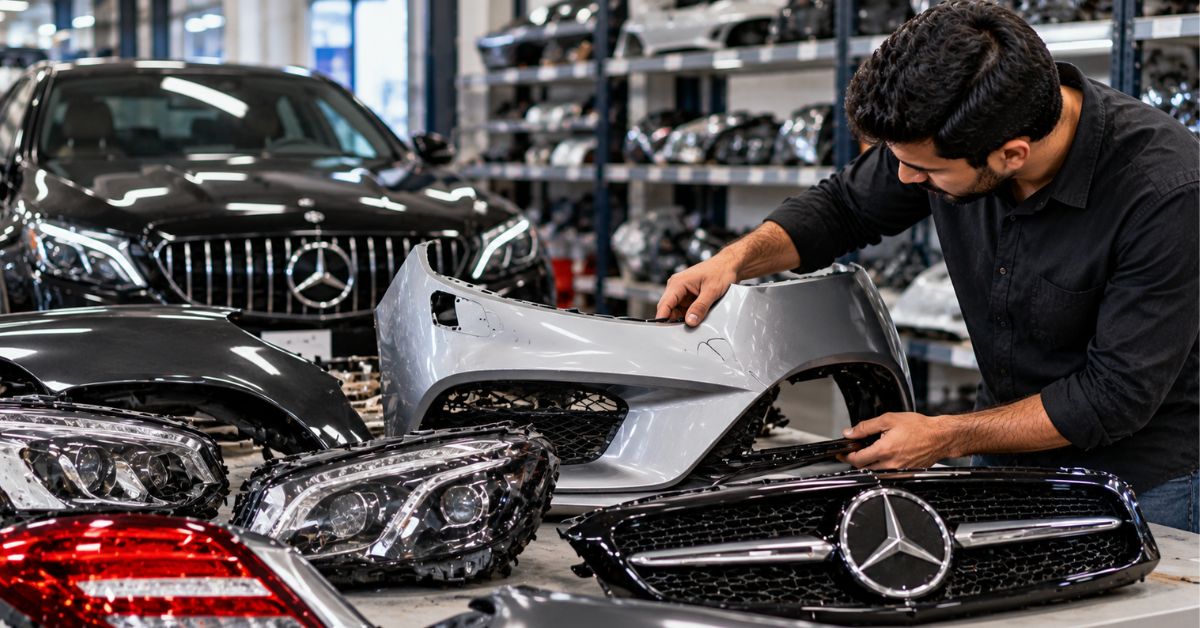
4. Will the replacement work with the car’s sensors and cameras?
Having the right number of holes is only one check. Ask whether the replacement accommodates the exact sensors, brackets, camera fittings and wiring arrangement already fitted to your car.
The workshop should identify the diagnostic checks and any calibration required by the model-specific repair procedure. A diagnostic scan and calibration are different tasks; one should not be presented as a substitute for the other.
Also ask about refinishing restrictions around sensor areas before approving paintwork. After collision repairs, the absence of a dashboard warning is not enough to confirm that every affected system works correctly. Request the relevant diagnostic and calibration records at handover.
5. What material and protective finish am I paying for?
Ask for the material specification and whether it matches the intended application. Appearance and weight alone cannot establish equivalence. For metal panels, ask about corrosion protection and how cut edges, seams and attachment areas will be protected during installation.
For plastic parts, request the material identification and preparation requirements. Confirm whether the surface coating is ready for the planned paint system or needs additional preparation.
In Qatar, discuss prolonged outdoor parking, sunlight and coastal exposure with the paint technician. Ask what finish warranty applies to fading, peeling or corrosion, rather than accepting an unsupported claim that a part is “suitable for Gulf weather.”
6. Can the workshop check fit before painting?
Arrange an appropriate trial fit before the part is painted or permanently altered. This allows the technician to assess mounting alignment, panel gaps, adjoining trims and, where relevant, latch operation.
Agree on what happens if the item cannot fit correctly. Who approves additional labour, and can the unmodified part be returned?
Extra cutting, drilling or bending should trigger a discussion about compatibility and the approved repair method. It should not become an automatic way to make an unsuitable part fit.
The workshop should also inspect the vehicle’s mounting structure. Accident damage beneath the panel can cause poor alignment even when the replacement part is correct.
7. What is included in the complete repair price?
Request itemised quotations in Qatari riyals. Compare the same scope of work rather than two headline part prices.
A bumper quotation, for example, should clarify whether it includes the cover alone or also the required grilles, brackets, trims and fittings. Ask separately about:
- Delivery and any special-order charges.
- Paint preparation, refinishing and colour blending.
- Installation, alignment and required replacement fasteners.
- Diagnostic checks and any necessary calibration.
SWAT’s auto body parts range in Doha includes categories such as bumpers, fenders, hoods, doors and grilles. Confirm the exact component and included accessories for your quotation.
An aftermarket part offers a meaningful saving only if its lower purchase price survives the additional work needed to complete the repair properly.
8. What happens if the part is wrong or develops a fault?
Get the return conditions before paying a deposit. Ask whether special-order items are returnable and whether trial fitting, removing labels or applying paint changes eligibility.
Separate the supplier’s parts warranty from the workshop’s installation and paint warranties. Clarify who pays removal and refitting labour if a defect appears after installation.
If an insurer is funding the repair, obtain approval for the proposed parts and repair scope. If the vehicle has warranty coverage, ask about the specific implications of the proposed replacement under your Qatar warranty terms.
Finally, distinguish stock physically available in Qatar from stock that still needs ordering, and request an expected delivery date.
Conclusion: Buy a documented repair, not just a replacement panel
Choose genuine Mercedes-Benz body parts when following the manufacturer’s collision-repair recommendation. If considering an aftermarket item, require a clear explanation of its suitability, limitations and complete installed cost.
The strongest purchase combines the correct specification, traceable supply, proper installation and written aftercare. Contact SWAT Auto Parts with your chassis number, photographs and workshop requirements to request a precise quotation. Keep those details with your repair records; they will make future replacements and compatibility checks easier.
Frequently Asked Questions
Are aftermarket parts the same as counterfeit parts?
No. An aftermarket part is independently supplied. A counterfeit falsely presents itself as genuine. Accurate labelling and traceable invoices help distinguish them.
Is a used genuine panel equivalent to a new one?
No. Previous damage, repairs, corrosion and removal methods can affect its condition. Genuine origin does not establish its remaining quality.
Will a genuine replacement arrive in my car’s colour?
Not necessarily. Confirm whether it is supplied unpainted, primed or finished. Colour matching and blending may require separate work.
Can a replacement part have a different number from the old one?
Yes. Part numbers can be superseded. Ask the supplier to verify the replacement number against your chassis number.

