
Radiator repair makes sense when damage is limited, the surrounding material is sound, and the work can restore reliable cooling. Replacement is usually the better choice when corrosion, brittle tanks, repeated leaks or extensive damage make another failure likely.
For drivers in Qatar, the decision should consider the radiator’s overall condition, the complete workshop bill and how the car is used. A cheaper repair offers little value if it leaves you facing another overheating problem.
Confirm the Radiator Is Actually at Fault
A rising temperature gauge does not automatically mean the radiator needs replacing. Cooling fans, the thermostat, water pump, pressure cap and hoses can cause similar symptoms. Coolant beneath the front of the car may also have travelled from a leaking connection.
Ask the workshop to identify the exact fault before quoting. Useful checks include:
- A cooling-system pressure test at the vehicle’s specified test pressure.
- Inspection of the tanks, seams, hoses, connections and pressure cap.
- Checks of fan operation, coolant circulation and airflow through the radiator.
- Inspection for contamination or damage elsewhere in the cooling system.
A pressure test helps locate leaks; it does not, by itself, prove that the radiator can remove enough heat.
SWAT Auto Parts lists diagnostics and cooling-system repairs among its garage workshop services in Doha. Start with an assessment so the proposed work addresses the actual cause.
If the engine overheats, pull over safely, switch it off and arrange assistance. Never open a radiator or coolant-reservoir cap while the system is hot.
When Radiator Repair Is Worth Considering
The strongest repair candidate has one identifiable defect and otherwise remains in good condition. A specialist may be able to repair an accessible metal joint or a small area of damage, depending on the construction and location.
On some radiators, a damaged tank or its seal can be replaced while retaining a healthy core. However, suitable parts must be available, and the sealing surface and retaining tabs must remain serviceable.
Plastic tanks require particular care. Certain localised cracks can be professionally welded, but a patch on aged, brittle plastic may leave the surrounding material vulnerable. Ask why the proposed method suits that particular tank.
Before agreeing, establish:
- What failed and whether the cause has been corrected.
- Which components will be repaired or renewed.
- How the finished radiator will be tested.
- What warranty covers the work.
A repair should restore useful service life. Simply making the visible drip disappear is not enough.
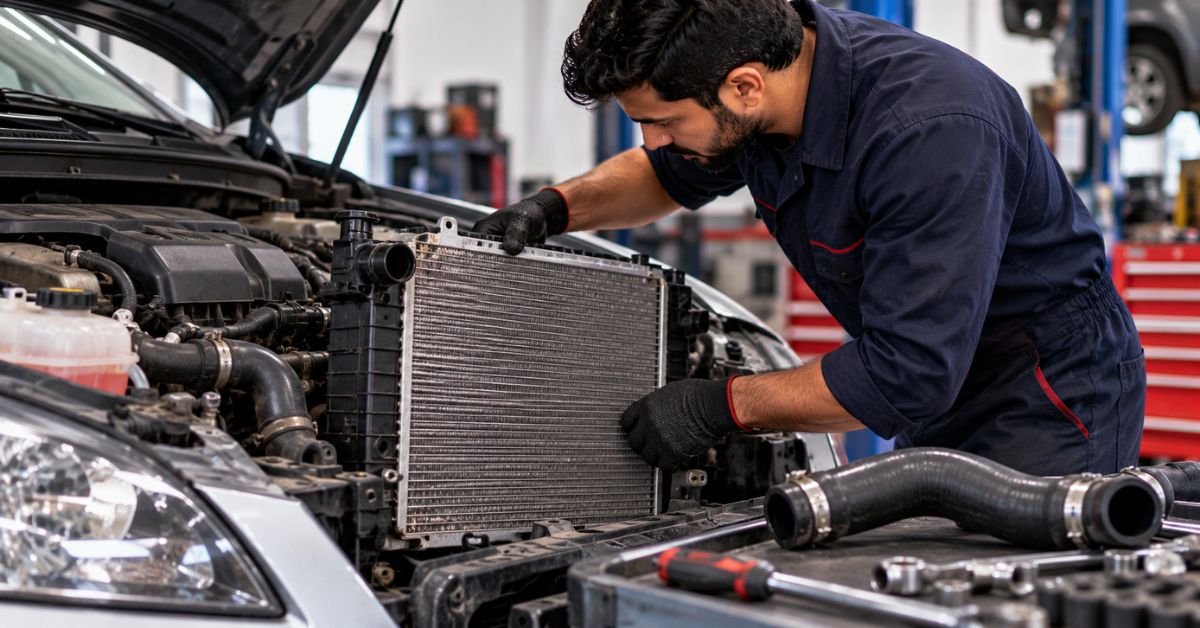
When Replacement Makes More Sense
Replacement becomes more convincing when damage extends beyond one repairable area.
Widespread corrosion: Several pinholes, weakened tubes or deteriorating fins suggest that sealing one leak may only expose the next weak point.
Brittle or distorted tanks: Multiple cracks, a damaged hose neck or a warped sealing area can undermine the reliability of a local repair.
Substantial impact damage: A crushed core, bent assembly or damaged mounts may affect coolant passages, airflow and installation security.
Persistent internal restriction: Cleaning may help with some deposits, but a flush cannot rebuild corroded metal or guarantee that severely blocked passages will recover.
Recurring failures: A radiator that develops another leak soon after repair deserves a broader assessment rather than another automatic patch.
Even then, identify why it failed. Excessive system pressure, unsuitable coolant or damaged mounting supports can shorten the life of a replacement too.
Compare Complete Quotes, Not Just Part Prices
Request written repair and replacement quotes in Qatari riyals with the same scope. Both should state the cost of removal and refitting, coolant, necessary seals or fittings, testing and any justified system cleaning.
Then compare warranty coverage, turnaround time and what happens if the repaired radiator fails again. Ask whether repeat removal and installation would be chargeable.
There is no universal percentage that makes repair worthwhile. A modest repair on a sound radiator may offer excellent value. A substantial repair bill on a deteriorating unit is harder to justify, especially when much of the labour would be repeated during replacement.
Also consider how long you intend to keep the car and whether unexpected downtime would disrupt work or family transport. The cheapest initial quote is only one part of the decision.
How Qatar’s Driving Conditions Affect the Choice
High ambient temperatures reduce the temperature difference available for rejecting engine heat. Slow traffic also means less airflow from vehicle movement, making correct fan operation especially important.
For a car used daily in Doha traffic, a repair should provide dependable cooling under those conditions. Ask the workshop to check operating temperature and fan performance with the air conditioning running, as appropriate for the vehicle.
Dust and debris around the radiator and air-conditioning condenser should also be inspected. Restricted external airflow may need cleaning, not radiator replacement. High-pressure washing can damage delicate fins, so cleaning should follow a suitable workshop procedure.
If You Replace It, Check Compatibility and Installation
Order against the chassis number or VIN, engine and transmission specification, then confirm the correct part number. A similar-looking radiator is not proof of compatibility.
The workshop should verify mounting points, hose positions, fan-shroud fit and any integrated transmission-cooler connections. Cooling capacity must also suit the vehicle; physical fit alone is insufficient.
After installation, the system needs the specified coolant mixture and the correct filling and bleeding procedure. Trapped air can cause overheating even with a new radiator.
Ask for a final leak check and operating-temperature assessment. Any contamination source or related component fault should be addressed before the vehicle returns to service.
You can contact SWAT Auto Parts with your vehicle details to discuss assessment and confirm suitable parts availability before authorising the job.
Conclusion: Choose the Option That Restores Reliability
Repair is sensible when the defect is isolated and the rest of the radiator has a credible service life ahead. Replacement is a stronger value when deterioration is widespread or another repair would leave significant uncertainty.
Base the choice on a documented diagnosis, comparable quotes and proper testing. Looking ahead, maintaining the correct coolant and investigating small losses early will help protect whichever option you choose. A successful job should restore confidence in everyday driving, not simply postpone the next workshop visit.
Frequently Asked Questions
1. Can a radiator leak be repaired without removing it?
Sometimes, particularly if the leak comes from an accessible connection. Core or tank work may require removal for access and testing.
2. Is radiator stop-leak a permanent repair?
It should not replace diagnosis. Some sealants can restrict narrow coolant passages. Use them only where the vehicle manufacturer specifically permits them.
3. How long will a repaired radiator last?
There is no dependable fixed lifespan. Remaining material condition, repair quality, coolant maintenance and the original failure cause all matter.
4. Does replacing the radiator require a new thermostat?
Not automatically. Replacement depends on its condition, test results and the vehicle’s service procedure. Ask the workshop to explain the recommendation.

